A practical guide to driving in Riga: restricted zones, paid parking areas, speed limits, winter tyre rules and tips for every type of traveller.
Driving in Riga: What to Expect
Driving in Riga is easier than in Rome or Paris — the traffic is lighter, the roads are generally well-maintained, and Latvians drive in a fairly orderly, unhurried way compared to some Southern European capitals. That said, the city has a pedestrianised Old Town (Vecrīga), a colour-coded paid parking system that confuses first-timers, and winter-tyre laws that carry real fines if ignored. None of this is complicated once you know the rules, but it's exactly the kind of local detail that doesn't show up on a rental car's dashboard.
If your trip is confined to central Riga — walking the Old Town, taking in the Art Nouveau district on Alberta iela, riding the funicular-style cable car in Kipsala — you genuinely don't need a car. Riga's public transport (trams, trolleybuses, buses) is cheap and frequent, and taxis or ride-hailing apps cover the rest. Where a car earns its keep is on day trips: Jurmala's beach towns are 25–30 minutes away, Sigulda and the Gauja National Park are about an hour, and a loop toward Cēsis or further into the Latvian countryside is far more flexible by car than by regional bus.
Riga's Restricted and Pedestrian Zones Explained
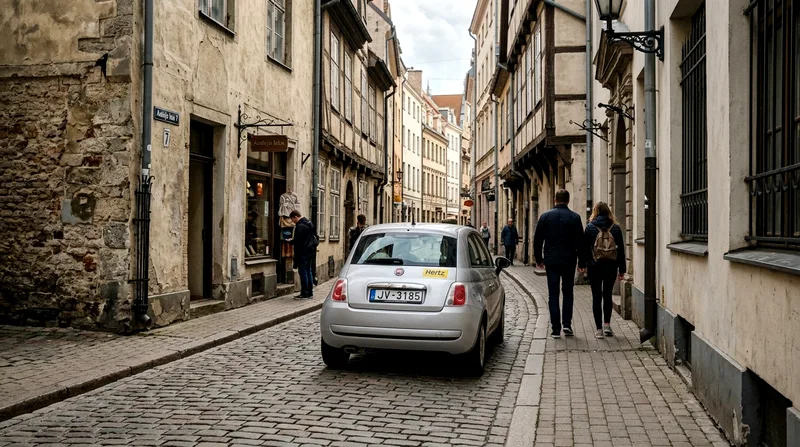
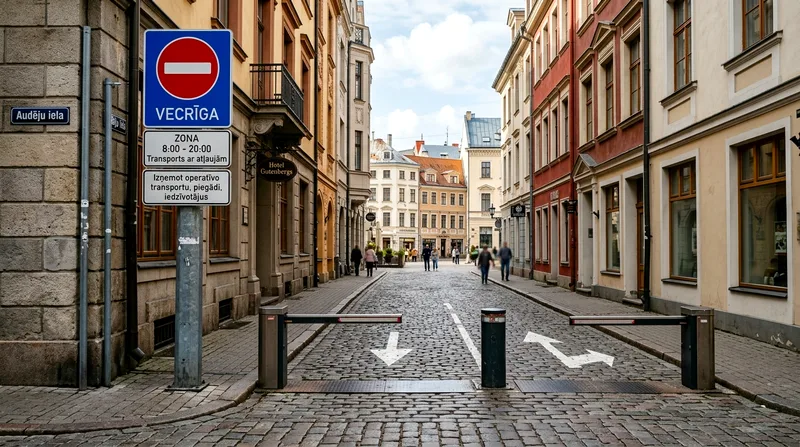
Most of Riga's Old Town is closed to general traffic. The narrow medieval streets around the Dome Cathedral, House of the Blackheads and St. Peter's Church are pedestrian-only, with access restricted to residents, delivery vehicles, and cars with a specific permit — typically arranged through a hotel if you're staying inside the zone. Entry points are marked with standard EU restricted-zone signage (a blue circular sign with a red border, often with a supplementary plate listing exceptions), and some streets have retractable bollards monitored by camera.
Don't assume you can "just drive in to drop off luggage." If your hotel is inside the Old Town, contact them in advance — many will give you a temporary access code or arrange to meet you at a boundary point instead. Driving in regardless, on the assumption a ticket is cheaper than the hassle, is a bad gamble: Latvian traffic enforcement does use fixed and mobile cameras, and fines for restricted-zone violations are processed by post or via the rental company weeks later, often with an added administrative fee tacked on by the rental agency itself.
Outside the Old Town, Riga drives like any mid-sized European capital — one-way systems around the city centre, a handful of multi-lane boulevards (Brīvības iela, Krišjāņa Valdemāra iela) that carry most through-traffic, and roundabouts rather than traffic lights at several junctions. There's no congestion charge and no low-emission zone of the kind you'd find in Krakow's city centre or several German cities — Riga hasn't introduced one, which is one less thing to plan around compared to driving in Western Europe.
Parking Zones, Costs and Where to Leave Your Car
Riga's paid parking areas are split into colour-coded zones, and this is the detail that catches out most visitors. The red zone covers the city centre and parts of the Old Town perimeter, and it's the most expensive and most time-limited, often capped at a maximum stay of a few hours during the day. The yellow zone forms a ring further out and costs less. The green zone, mostly residential and outer districts, is cheaper still and sometimes free in the evenings and on Sundays. Paid parking generally applies on weekdays and Saturday mornings, with most zones free overnight and on Sundays — but check the signage on the specific street, because exceptions exist.
Payment is usually by app (mobile parking payment is standard and often cheaper than the meter rate), SMS, or at a nearby pay-and-display machine. If you're driving a rental car with foreign plates, download a parking app before you arrive rather than hunting for one once you're circling a block — Mobilly is the most commonly used system in Riga.
Riga's red, yellow and green parking zones get cheaper the further you are from the Old Town, so match the zone to how long you're staying.
Riga parking zones compared: cost, location and best use
| Zone | Location | Relative cost | Typical time limit | Best for |
|---|---|---|---|---|
| Red zone | City centre, Old Town perimeter | Highest | Short stay (hours) | Quick errands, not full-day visits |
| Yellow zone | Ring around centre | Medium | Longer daytime stays | Old Town day trips, short walk in |
| Green zone | Outer/residential districts | Lowest | Often unrestricted evenings/Sundays | Multi-day stays, budget parking |
| Multi-storey car parks | Near station, riverside | Flat daily/hourly rate | Full day or overnight | Visitors wanting predictable cost |
Typical zone structure; exact rates, hours and boundaries change periodically, so check current signage or the city parking authority before you park.
Key Latvian Road Rules for Visitors
Latvia drives on the right, and road signs follow standard EU conventions, so nothing here will feel alien if you've driven in Germany, Poland or the Nordic countries. A few rules are stricter than visitors expect, though. Headlights must be on at all times, day and night, year-round — this applies outside built-up areas at minimum, and most drivers simply leave them on everywhere to avoid thinking about it. The blood alcohol limit is 0.5‰, dropping to 0.2‰ for drivers with less than two years' experience — effectively zero tolerance for new drivers, so don't assume "one beer" is fine the way it might be elsewhere.
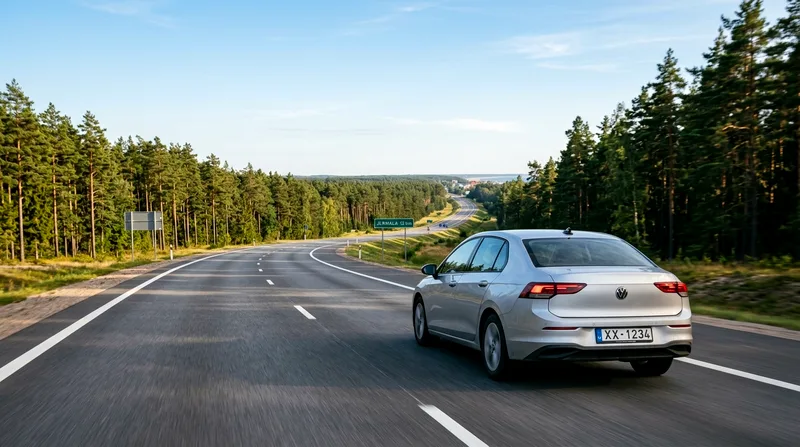
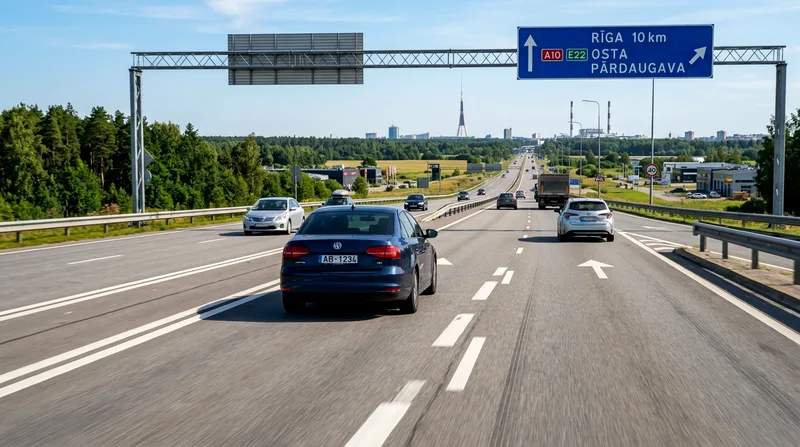
Speed limits are typically 50 km/h in built-up areas, 90 km/h on rural roads, and up to 110–120 km/h on specific motorway-standard stretches — signage will confirm the exact limit, and it changes often enough on the Via Baltica-type roads that cruise control without attention is a bad habit. Speed cameras, both fixed and mobile, are used throughout the country, and fines issued to rental vehicles are typically billed to the renter via the rental company, sometimes months later with a service charge added.
Every vehicle is legally required to carry a reflective warning vest, a warning triangle, and a first-aid kit — if you break down or stop at the roadside, the vest must be worn before you step out of the car, the same rule you'll find across most of Central and Eastern Europe. Rental cars in Latvia are required to have this kit; check it's actually present when you pick up the car, not just claimed on the paperwork.
Winter Driving – Tyres, Lights and Conditions
Winter tyres are mandatory in Latvia, typically required from around December through March, though exact dates are set annually and tied to road conditions rather than a fixed calendar in some years — check the current requirement before you travel if you're driving in late autumn or early spring, since the window can shift. Driving on summer tyres during the mandatory period is a fineable offence, and more importantly, it's genuinely dangerous — Latvian winters bring real ice and packed snow, not just a light dusting, and Riga's road crews, while reasonably efficient, can't clear everything immediately after a heavy snowfall.
If you're renting a car for a winter visit, confirm with the rental company that winter tyres are already fitted — reputable agencies operating in the Baltics switch over automatically for the season, but it's worth asking rather than assuming, especially with budget operators. Studded tyres are permitted within the mandatory winter period and common on Latvian-registered cars; a rental with ordinary winter tyres (non-studded) is still legal and fine for city and highway driving, just less confidence-inspiring on rural ice.
Daylight hours shrink dramatically in a Baltic winter — sunset by mid-afternoon in December — so plan any day trip to Sigulda or Jurmala with that in mind. Combined with the headlights-always-on rule, winter driving in Riga is manageable but demands more caution than a summer visit, particularly on unlit rural roads outside the city.
Practical Tips by Traveller Type
A solo traveler based in central Riga rarely needs a car at all — trams and the compact Old Town cover most of what you'll want to see, and a rental just becomes a parking bill. If you do want one day of countryside driving, it's often cheaper to rent for 24 hours specifically for a Sigulda or Cēsis run than to hold a car for your whole stay.
Couples planning a longer Baltic road trip — Riga to Tallinn is about 4–4.5 hours, Riga to Vilnius around 3 hours — benefit most from a car, since inter-city trains between the three Baltic capitals are limited and buses, while decent, add hours. Factor in one-way rental fees if you're picking up in Riga and dropping off in Tallinn or Vilnius; they're rarely trivial.
Families with children should budget for the child-seat rule above and treat Jurmala as the easy win: 25 minutes by car versus a similar time by train, but a car lets you combine a beach stop with lunch in Kemeri or a detour to the Ragakapa nature trail without timetable pressure.
Senior travelers who find walking long distances tiring often prefer a car for day trips but should know that Old Town hotels rarely have on-site parking — factor a short walk with luggage into the plan, or choose a hotel just outside the pedestrian zone instead.
European travelers used to low-emission zones in Germany or congestion charges in London will find Riga refreshingly simple on that front — there's no equivalent charge — but shouldn't assume Latvian insurance excess and fuel policies match home-market norms; read the rental agreement's excess amount carefully, since it varies more between Baltic operators than in Western Europe.
World travelers comparing this to Southeast Asian or South American driving will find Latvia closer to Finland or Poland in style: rule-following, camera-enforced, and unforgiving of casual fine-dodging, since EU-wide cross-border fine recovery agreements mean a Latvian speeding ticket can follow you home.
Checklist Before You Drive in Riga
Before picking up a car at Riga Airport or in the city, confirm five things: that winter tyres are fitted if you're traveling between late autumn and early spring, that a reflective vest and warning triangle are in the vehicle, that you understand the colour-zone parking system and have a payment app ready, that your hotel has told you how to approach the Old Town's restricted streets if you're staying inside them, and what the insurance excess actually is — not just that "insurance is included." A low headline rental price with a high excess is a common trap across the Baltics, not unique to Latvia, but worth checking line by line before you sign.
Riga Airport itself sits about 10 km from the city centre, with rental desks for the major international agencies in the arrivals area — a straightforward pickup, and one reason a fly-drive combined with a few days in Riga and a loop to Sigulda works well logistically.
Frequently asked questions
Can I drive into Riga's Old Town?
Generally no — most streets in Vecrīga are pedestrian-only, with access limited to residents, deliveries and permit holders such as hotel guests. If your accommodation is inside the zone, ask them in advance how to get a temporary access permit or where to meet instead of driving up to the entrance and hoping.
Are there congestion charges or low-emission zones in Riga?
No, Riga doesn't currently operate a congestion charge or low-emission zone, unlike many Western European cities. The main restriction to plan around is the Old Town's pedestrian zone and the paid parking system, not an environmental charge.
When are winter tyres mandatory in Latvia?
Winter tyres are required roughly from December to March, though exact start and end dates are set based on conditions and can shift slightly year to year. If you're driving in late autumn or early spring, check the current requirement before you pick up a rental car.
Where is the cheapest parking near Riga Old Town?
Yellow-zone streets a 10–15 minute walk from the centre, or multi-storey car parks near the central train station and riverside, are cheaper than red-zone street parking right against the Old Town walls. Red-zone spots are also time-limited, making them a poor fit for a full day of sightseeing.
Do I need a reflective vest in my hire car in Latvia?
Yes. Latvian law requires every vehicle to carry a reflective vest, a warning triangle and a first-aid kit, and the vest must be worn if you step out of the car on the roadside. Check your rental car actually has these items at pickup rather than assuming the paperwork is accurate.